IIM Ranchi Hosts Space Conclave 2026: Charting a Shared Roadmap for India’s Space Economy
· Free Press Journal
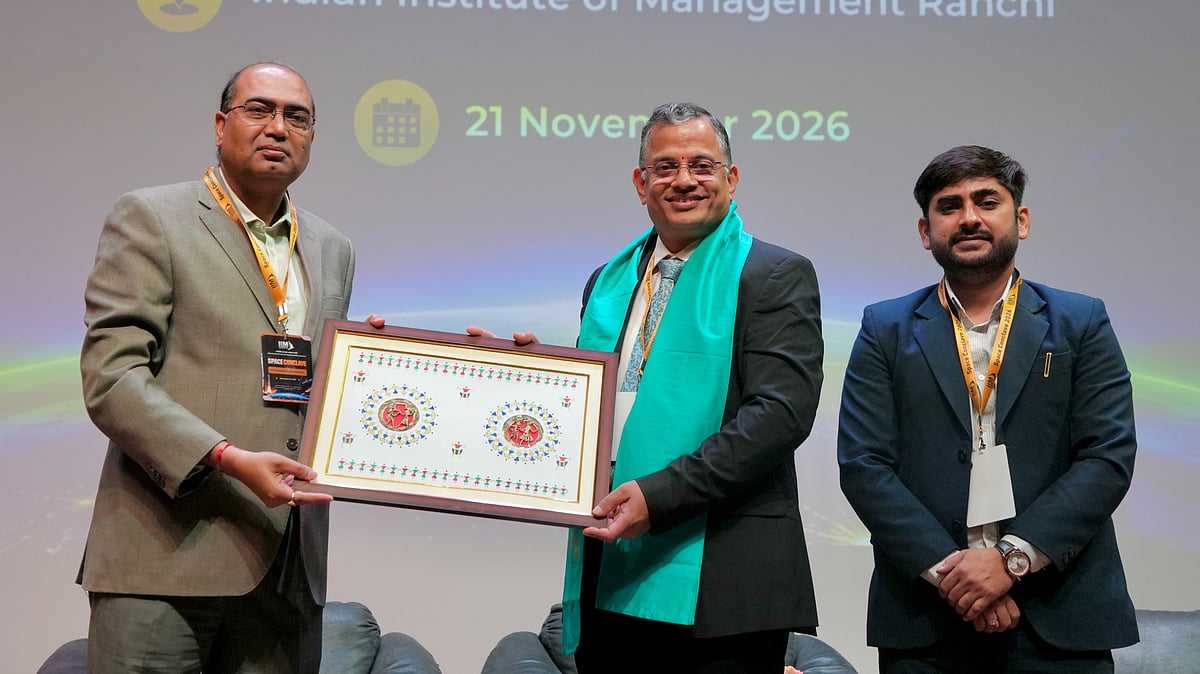
IIM Ranchi successfully hosted “Space Conclave 2026: Charting a Shared Roadmap for India’s Space Economy,” centered on "India’s $44 Billion Space Economy Vision" under ISRO’s Space Vision 2030. Featuring a keynote address by Radha Krishna A., Chairman and Managing Director of NewSpace India Limited (NSIL), alongside Prof. Deepak Kumar Srivastava, Director, IIM Ranchi, and Prof. Arun Singh Rana, Conclave Chairperson, the event witnessed active participation from senior space-sector leaders, academicians, startup founders, legal experts, researchers, and students.
Delivering the opening address, Prof. Arun Singh Rana marked 63 years since India’s first rocket launch from Thumba, Kerala, in 1963, tracing the nation’s journey from transporting parts on bicycles to landing near the Moon’s south pole. Backed by sector reforms, the Indian Space Policy, IN-SPACe, and NSIL, India’s $8.4 billion space economy has grown from a single startup in 2014 to nearly 440 in 2026, with private rockets now lifting off from Indian soil. To achieve the 2033 target of a $44 billion economy and expand global market share from 2% to 10%. Prof. Rana drew a cricket analogy stressing that just like building big partnerships on the field, advancing the space sector requires close collaboration among the government, ISRO, startups, investors, industry, and academia.
Visit palladian.co.za for more information.
Director, IIM Ranchi Prof. Srivastava highlighted that space has evolved from a domain of rockets and scientists into one of the world's fastest-growing, multi-billion-dollar industries. This transformation into a thriving business vertical relies heavily on institutional support. Driven by clear national policies that encourage private investment, India's space sector is now booming, as evidenced by the emergence of over 400 domestic space-tech startups.
Addressing why a management institute like IIM Ranchi is exploring this sector, Prof. Srivastava emphasized that modern business education must move beyond merely teaching efficiency. True growth requires newness, innovative ideas and fresh business models that create new value. As academician, he urged students to pioneer new disciplines like space marketing, space finance, and space economics. And sensitized future business leaders, encouraging them to look beyond conventional industries and recognize the immense commercial opportunities emerging within the global space economy.
In his keynote address, Radha Krishna A. highlighted that hosting a space conclave at a management institute marks a critical shift from merely achieving "escape velocity" in rocket launches to driving "economic velocity" for commercial profitability. He noted that India's space economy, currently valued at $8.5 billion, is projected to reach $44 billion within seven years and $100 billion by 2040. To realize this vision, he outlined the distinct roles of the national space ecosystem: ISRO focusing on research, IN-SPACe acting as the private sector regulator, and NSIL serving as the commercial arm.
Emphasizing the massive career opportunities for business graduates, Mr. Krishna, pointed out that rocket and satellite manufacturing comprises only 10 to 15 percent of the sector, the remaining 85 to 90 percent lies in downstream data services like agriculture, banking, and weather forecasting, where innovative business models are essential. Aided by government reforms and a ₹1,000 crore fund, over 400 space startups have already emerged, a growth further accelerated by NSIL transferring more than 100 technologies to private firms. He cautioned that space ventures demand extreme reliability and patient capital, as replacing a failed satellite can take up to four years. Ultimately, the sector’s true value is measured by earthly socio-economic benefits, such as disaster warnings and restoring barren land and by providing affordable solutions to developing nations. Tracing India's journey from transporting rocket parts on bicycles in 1963 to the upcoming Gaganyaan mission, he concluded that while scientists and engineers have built the launchpad to the stars, it is now up to business leaders and entrepreneurs to build a thriving economy around it.
During the conclave, various panel discussions explored ways to boost the space economy through educational development, future planning, and startup promotion. The first panel, moderated by Prof. Kushagra Sharan, focused on space education. Pannel featured NCERT Associate Professor Dr. Arun Pratap Sikarwar, Starscapes Experiences Director Dr. Smriti Mahajan, and Space Lawyer Ms. TanuJoshi. Dr. Arun highlighted that under NEP 2020, space science is being integrated into the school curriculum for classes 6 to 12, featuring age-appropriate content designed to spark students' curiosity. Dr. Smriti emphasized the need to make space information engaging for children as a foundation for the space economy. She cited an initiative in Northeast India where rural youth and locals are trained as "space guides," which not only generates employment but also inspires broader participation in space education. Adding a different perspective, Ms. Tanuintroduced Space Law as an emerging and highly promising legal dimension. She noted that while the field is currently underexplored, youth who learn about space policies and the legal frameworks surrounding astronomy and space science will find it a fascinating and rewarding career path.
Throughout the day, the conclave featured multiple engaging sessions, including a fireside chat titled "The Private Space Revolution" with Shashwat (Founder's Office, Piersight) and former ISRO space scientist Manish Purohit. The discussion highlighted the shift from government-led exploration to vast economic opportunities. Backed by the New Space Policy, private companies and startups are now leveraging ISRO's R&D and technological expertise to drive independent innovations and compete on a global scale. The speakers also explored how to measure the impact of space education through industry growth and new employment opportunities. They emphasized the need to move beyond rote memorization toward genuine conceptual awareness, stressing that space economics is now just as important as space science.
The conclave further explored strategic growth through two pivotal panel discussions. Prof. Manish Bansal moderated a session on "Building India's Space Economy Value Chain," featuring expert insights from Dr. Shaijumon C.S. (Professor of Space Economy, IIST), Amandeep Singh (Space Expert specializing in Air & Space Law), and Krishnamurthy Manjunatha (Founder Executive, Orbit2.Space, and Chairman, Mars HomeBase Organization). Following this, Prof. Arun Singh Rana led a dynamic discussion on "India's Space Diplomacy: Policy, Technology, and Global Partnerships." The panel shared by Radha Krishna A. (CMD, NSIL Ltd.), Gp Capt (Dr.) Ajey Lele (Dy. Director, MP-IDSA), Ms. TanuJoshi (Space Lawyer), and Krishnamurthy Manjunatha, collectively emphasized the critical need to explore and implement every possible initiative to accelerate the holistic development of India's space economy.
The Space Conclave 2026 ended with a clear purpose. By bringing business and space science together, IIM Ranchi aims to inspire future leaders to look beyond traditional jobs and discover the massive business opportunities in the space industry.