Standing MRI Explained: How Weight-Bearing Scans Help Detect Spine And Joint Problems
· Free Press Journal
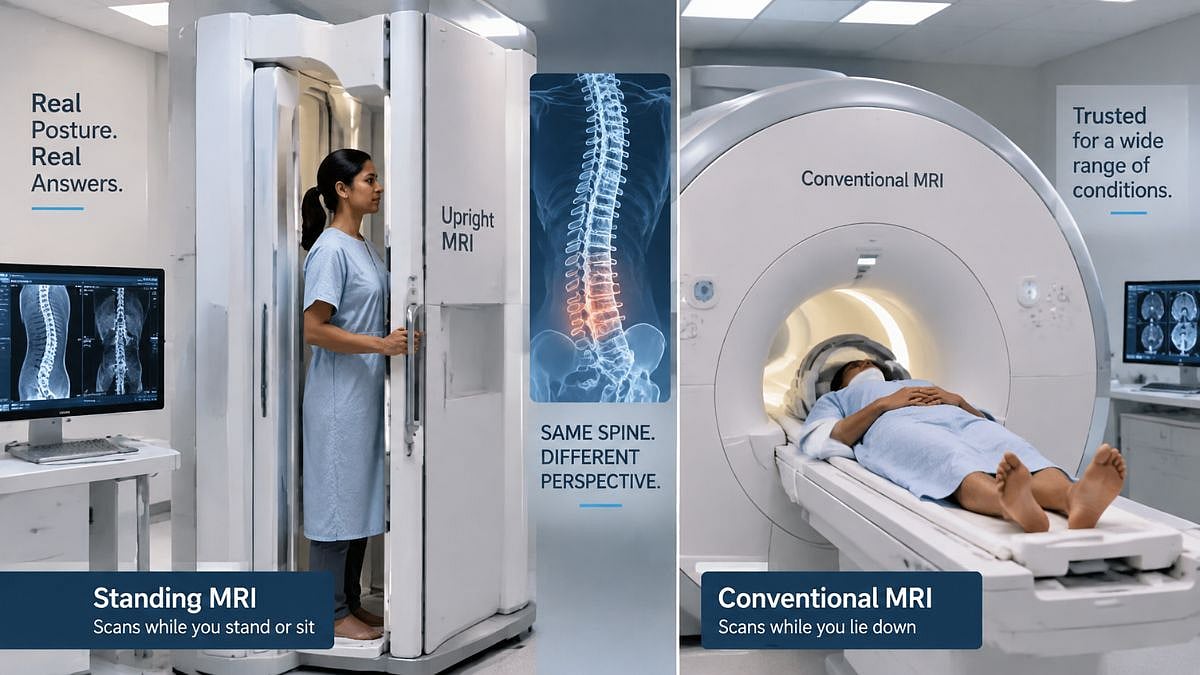
Mumbai, September 19, 2026: What if your back hurts when you stand, but your MRI is done while you are lying down? A specialised standing or upright MRI may offer doctors a different view by scanning the spine and joints while the body is bearing weight.
The technology has recently drawn attention after a veteran Bollywood actor shared photographs of himself undergoing a standing MRI before lumbar-spine surgery at a Mumbai hospital.
Visit freshyourfeel.org for more information.
But doctors caution patients against viewing it as a superior replacement for a conventional MRI. Dr Dhiraj Sonawane, Head of the Orthopaedic Department at Sir JJ Hospital, said upright MRI has a very specific role and is mainly useful when doctors need to understand how a problem behaves when the patient is standing, bending or bearing weight.
“The upright MRI has specific indications. It is a dynamic MRI, but the quality of imaging is not as good as a conventional MRI. For 99.99% of routine MRI examinations, conventional MRI is sufficient,” said Sonawane.
How Upright MRI Differs
Unlike a conventional MRI, in which the patient generally lies flat, an upright MRI can take images while the patient is standing or sitting. This matters because the spine and joints behave differently when they carry the body's weight. Some patients may have little discomfort while lying down but develop pain, numbness or weakness while standing or walking.
“Some patients have problems that increase when they stand or bend, but these may not be visible in the same way when they are lying down. In such cases, an upright MRI can show the problem better,” Sonawane said.
For patients, this could be relevant in selected cases of spinal instability, changes in spinal alignment, certain types of spinal narrowing, disc-related problems and some weight-bearing joint conditions. However, the scan is not required simply because a patient has back, hip or knee pain.
Dr Gaznafar Patel, Consultant Orthopaedics, Minimal Invasive/Robotic Joint Replacement and Sports Medicine Specialist at Wockhardt Hospitals, Mumbai Central, said the main benefit was understanding how the body behaves under normal load. “Its main advantage is that it can provide information about how the spine or a joint behaves under physiological loading,” he said.
Benefits And Limitations
Another potential advantage is comfort. The more open design can be easier for patients who feel claustrophobic, or frightened inside the enclosed tunnel of a conventional MRI. MRI itself does not use ionising radiation.
However, Sonawane cautioned against creating unrealistic expectations. Upright systems generally have lower magnetic field strength, meaning they may produce less detailed images than conventional 1.5T or 3T machines. The technology is also available at only a limited number of centres in Mumbai and Bengaluru, he said.
Cost is another consideration. “It can be almost twice as expensive as a routine MRI,” Sonawane said.
For Mumbai's crowded public hospitals, the technology could potentially be considered as a specialised additional service for selected patients rather than replacing conventional MRI. The key question is whether enough patients have conditions where weight-bearing images would add clinically useful information to justify the cost and infrastructure.
For patients, the message is simple: standing MRI is not a “better MRI”; it is a different MRI for a specific clinical question. The treating doctor should decide which type of scan is appropriate based on the patient's symptoms and suspected condition.
Differences Between Standing MRI And Conventional MRI Machine
Standing MRI
Patient can be scanned standing or sitting
Shows the body under weight-bearing conditions
May help assess spinal stenosis, spondylolisthesis, spinal instability and alignment problems
May be useful in selected hip and joint alignment/weight-bearing problems
Conventional MRI
Patient usually lies flat
Used for a wider range of conditions including disc prolapse, spinal stenosis, tumours, ligament injuries and joint disorders
Provides detailed assessment of discs, nerves, cartilage, muscles and soft tissues
1.5 Tesla and 3 Tesla machines generally provide higher-resolution images
Also Watch:
Mumbai Healthcare Update: Patients To Get MRI Facility At 4 BMC Hospitals Within 3 Months As New Machines ArriveUses Of Standing Or Upright MRI
Hip joint alignment, Hip impingement, Spinal stenosis, disc problems, Knee alignment, Ligament-related problems
Why Some Patients May Find Standing MRI Easier
Less Fear: The machine is more open, so patients may feel less trapped.
No Narrow Tunnel: Unlike a regular MRI, there is no long, closed tube around the patient.
More Comfortable Position: Patients can be sitting or standing instead of lying down.
Better For Claustrophobic Patients: Those who fear closed spaces may find the open design easier.
Easier Communication: Patients can generally see and communicate with staff more easily.
Useful For Some Elderly Patients: Standing or sitting may be more comfortable than lying still for a long time.
Still Need To Stay Still: Movement during the scan can affect the quality of the images..
To get details on exclusive and budget-friendly property deals in Mumbai & surrounding regions, do visit: https://budgetproperties.in/