Manual or auto? Choosing between JMC’s new two-wheel drive Vigus
· Citizen
Jiangling Motors Corporation, better known by its abbreviation JMC, is one of China’s oldest vehicle manufacturers having been founded in 1947.
Back but different
A commercial vehicles specialist brand, its arrival on South African soil earlier this year isn’t new as it had a presence during the original Chinese vehicle influx two decades ago.
Visit mwafrika.life for more information.
As with most of its countrymen, though, it has undergone a complete transformation from the early Isuzu badged products sold locally.
Imported by Salvador Caetano Auto, whose portfolio also includes GAC, the latest Vigus also no longer relies on Isuzu hardware but form Ford.
Not a strange name
A partnership signed in 1997, the Vigus is in fact the third JMC-Ford joint venture model to be sold locally, the others being the Vigus Pro and the Territory, which is built by JMC and sold as the Equator Sport in China.
Known as the Boarding in China, which ironically was the name the original Isuzu-based model was sold under in South Africa, better reception of the later “real” Vigus all but explains why the same has been opted for.
Manual vs automatic
Part of an eventual four model bakkie range that will soon include the Grand Avenue and the off-road designated Dadao, the arrival of Vigus for the weeklong stay didn’t come in singles.
Initially, the test unit came in the shape of the 4×2 fitted with the eight-speed automatic gearbox. Upon its collection, its replacement turned out to be the same 4×2, but with the six-speed manual.
Effectively two of the three available Vigus models available, the other being the range topping 4×4 automatic, the pair of 4x2s differ more than just on transmission options.
A direct comparison, therefore, couldn’t be ignored, especially as both would also show their prowess at Gerotek with Road Test Editor Mark Jones behind the wheel.
Styling
Unlike the older Vigus Pro, the Vigus is off to a better start as the Ford EcoSport-inspired looks have been dropped for a bulky American-type aesthetic.
Appearing similar to the Chevrolet Silverado at the front, but with obvious Ranger and D-Max influence at the rear and side, the Vigus is unlikely to simply fade into the background.
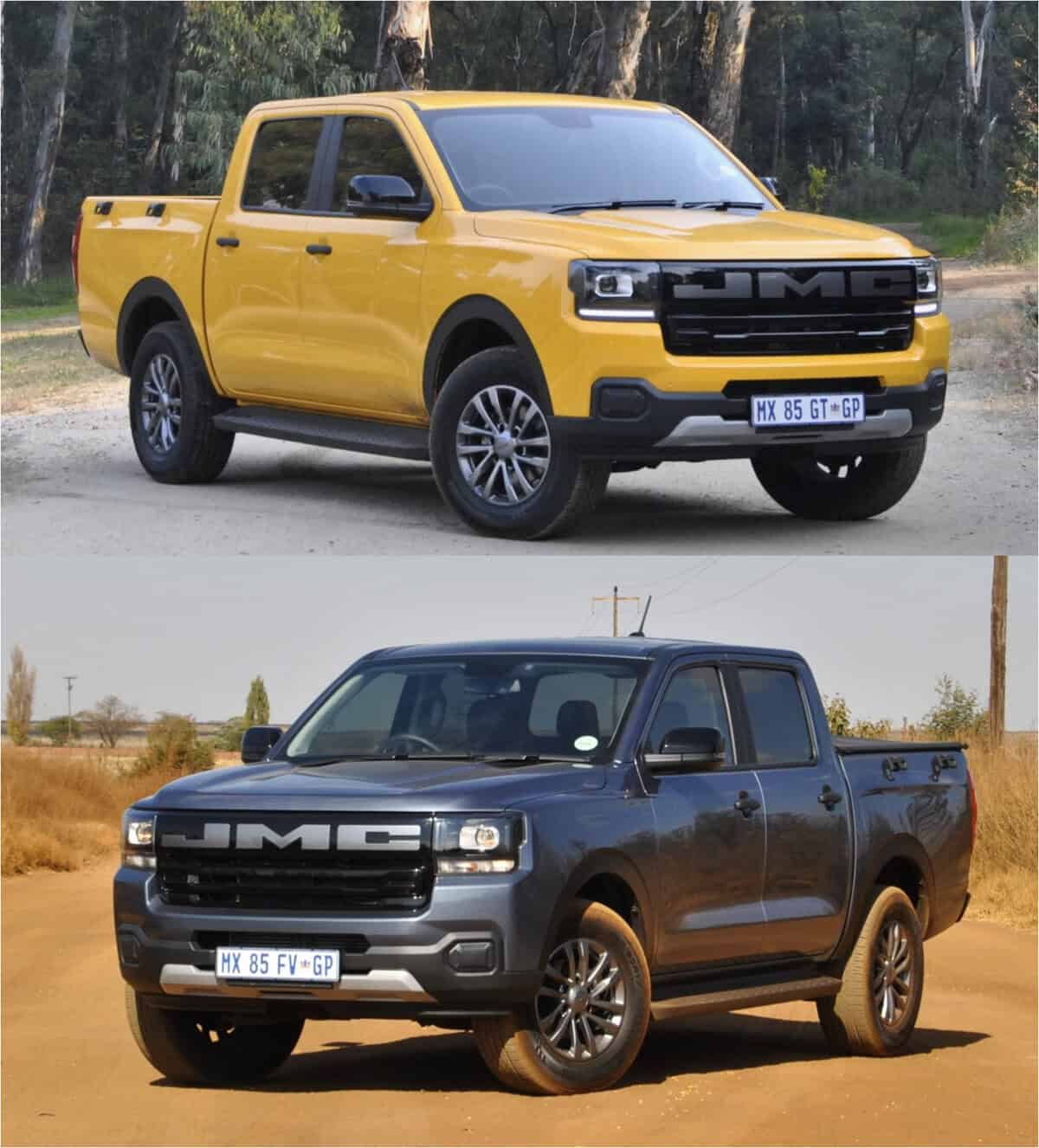
Slab-sided and striking in the case of the automatic, which arrived decked-out in a colour called Engineering Yellow, both variants ride on 17-inch alloy wheels that just manage to fill the wheel aches.
Automatic (top) and manual (bottom) Vigus have no clear aesthetic differences. Picture: Charl BoschThe JMC badge prominent across the sealed upper section of the grille, both also get side-steps as standard, while the manual, which had been finished in Yujing Grey, came fitted with a soft tonneau cover.
Most likely as a result of the Vigus being more of a workhorse than a leisure bakkie, JMC has resisted equipping it with colour-coded door handles or LED headlights.
Both variants ride on 17-inch alloy wheels. Picture: Charl BoschHowever, the chromed “JMC” and “Vigus” logos on its tailgate adds a classy touch, as does the stepped rear bumper often not available on bakkies at this price point.
In fact, the only oddity are the external mounting anchors on the side of the loadbox, Although tie-down hooks are present inside, the four external mounts feel cheap and could lead to long-term body damage if used regularly for heavy items.
Given the Vigus’ segment focus, this is likely to happen more than once as it has a handy 915 kg payload and a 1.5 m by 1.6 m cargo bed. The claimed ground clearance is 210 mm.
Inside
Opening the door reveals the biggest departure from the Vigus Pro, and indeed, any thoughts of the Vigus feeling and looking like a Ford or Isuzu.
A design unique to JMC, both the manual and automatic receive a freestanding nine-inch instrument cluster display recessed far enough into the dashboard to avoid the typical Chinese vehicle problem of being obscured by the steering wheel.
In fact, this is unlikely to happen as the manually adjustable seat drops all the way to the floor for taller drivers.
Only the automatic comes has the 12.8-inch infotainment display. Picture: Charl BoschLess modern is the mint green graphics seemingly taken from the erstwhile Chevrolet TrailBlazer, and the good looking but impractical two-tone black-and-white fabric seats.
As expected, cabin fit-and-finish is more about longevity than being plush. In this instance, the plastics are hard but solid, and the patterned finish on the passenger’s side of the dashboard an equally nice touch.
However, the fingerprint-friendly piano-key black centre console is less appealing, as is the imitation stitch work on the dash.
A dot matrix-style instrument cluster is standard. Picture: Charl BoschThe biggest notable difference is on the entertainment front. On the manual, an LCD audio system features, along with conventional buttons for the air-conditioning system.
On the automatic, this is replaced by a 12.8-inch infotainment display with Apple CarPlay and Android Auto, which required a redesign as the various ventilation buttons now reside below the central air vents.
At the same time, the automatic gains switchgear for the cruise control on the left-hand steering wheel spoke, and, as a result of the infotainment, serves as the display for the reverse camera.
Manual Vigus makes do with a conventional LCD audio system. Picture: Charl BoschA further incentive is the display being relatively easy to fathom despite appearing the opposite, yet the lack of a physical audio button will be an annoyance for some.
More irksome are the electric windows which open and close the wrong round; “up” for open and “down” for closed.
Space
Space up front is impressive and the large storage slot in front of the gear lever a bonus.
Vigus’ rear quarters is spacious, with little head or legroom complaints. Picture: Charl BoschEven more impressive is rear passenger head-and-legroom, which comes as little surprise given the Vigus’ market of origin. However, the lack of an armrest and rear air vents won’t sit pretty with everyone.
Power
In a further surprise, starting the Vigus is still done by a key inserted into an ignition barrel as no variant, including the 4×4, comes with push-button start.
Six-speed manual gearbox suffers from too short ratios. Picture: Charl BoschNestling up front, the Vigus is motivated by a 2.5-litre turbodiesel engine that makes 123 kW, but 410 Nm of torque in the manual and 430 Nm on the automatic.
Akin to an old Isuzu-sounding unit on start-up, once on the move, the deliverance of power couldn’t be more different.
Eight-speed automatic is smoother, but needs a manual override instead the provided so-called “low” setting. Picture: Charl BoschWhereas the automatic is relatively smooth but prone to hunting when shifting down, the manual is beset with way too short ratios and propensity to run out of puff quickly.
Indeed, the engine doesn’t like going over 2 700 rpm and one more than few occasions, hitting the gate between second and third took place.
Taking on Gerotek
In the confines of Gerotek, the manual’s lag was obvious as the key overtaking speed from 60 km/h to 100 km/h and from 80 km/h to 120 km/h took 7.7 and 10.6 seconds respectively.
By comparison, the automatic required 6.7 seconds and 9.1 seconds, while at the same time, getting from 0-100 km/h in 12.4 versus 13.2 seconds.
While more responsive low-down compared to the automatic, even with its 20 Nm torque deficit, the ratios will pose a long-term annoyance, even as a workhorse.
At the same time, a manual override for the automatic would alleviate some of the gearbox’s hunting.
On the move
As much as seat comfort feels good, the Vigus’ ride tends be on the bouncy side with sudden surface changes.
Both manual and automatic feature a two-tone black-and-white cloth upholstery finish. Picture: Charl BoschAdmittedly, this will improve with a few 100 kg over the rear axle. General ride quality is still more than acceptable.
Refinement, considering the Vigus’ segment focus, is relatively good as JMC has made a worthwhile effort to keep both wind and engine noise filtering into the cabin down. A few audible rattles were present on the automatic, but absent on the manual.
Consumption
The Vigus’ main standout, however, was fuel consumption. During the seven-days, the automatic registered a best of 7.7 L/100 km over 501 km, and the manual a marginally better 7.5 L/100 km over 409 km.
Conclusion
By no stretch will JMC’s return to the bakkie segment trouble the likes of Ford, Toyota, Isuzu or maybe even Mahindra among the mainstream fraternity.
At R399 900 for the manual and R459 900 for the automatic, smaller players such as Mitsubishi, Peugeot and lower-spec Chinese offerings from GWM, Foton and LDV are directly in the firing line from what is a decent if not earth-shattering product.
Striking a balance between workhorse and above affordable levels of luxury, the Vigus makes for a well devised entrant and definitely worth the premium over the Vigus Pro.
Road Test Data
Manual- Model: JMC Vigus 2.5D 4×2
- Gearbox: 6-speed manual
- Engine: 2.5-litre turbodiesel
- Power: 123 kW @ 3 000 – 3 400 rpm
- Torque: 410 Nm @ 1 400 – 2 000 rpm
- Licensing Mass: 1 820 kg
- Power to Weight: 68 kW / Tonne
- Power to Capacity: 49 kW / Litre
- 0-100 km/h: 13.21 Seconds
- 1/4 Mile (402.34 m): 18.88 Seconds @ 118.32 km/h
- 1/2 Mile (804.68 m): 29.76 Seconds @ 144.91 km/h
- 60-100 km/h: 7.72 Seconds (in 4th Gear)
- 80-120 km/h: 10.67 Seconds (in 5th Gear)
- 60-140 km/h: 21.54 Seconds (from 4th Gear)
- Claimed Top Speed: 165 km/h
- Fuel Consumption: 7.0 L/100 km Claimed (8.0 L Test Average)
- Fuel Tank Size: 75 litres
- Fuel Range: 1 071 km Claimed (938 km on Test)
- CO2 Emissions: 186 g/km
- Vehicle Odometer: 3 507 Km
- Test Temperature: 10 Degrees
- Tyres Size: 265/65 R17
- Tyres Make: Hilo Sport XV1
- Warranty: 5 Year/200 000 Km
- Service Plan: 5 Year/65 000 Km
- Priced From: R399 900
- Test Date: 17 June 2026
- For more information and latest pricing visit www.jmcsouthafrica.co.za
- Model: JMC Vigus 2.5D 4×2 AT
- Gearbox: 8-speed automatic
- Engine: 2.5-litre turbodiesel
- Power: 123 kW @ 3 400 rpm
- Torque: 430 Nm @ 1 600 – 2 000 rpm
- Licensing Mass: 1 840 kg
- Power to Weight: 67 kW / Tonne
- Power to Capacity: 49 kW / Litre
- 0-100 km/h: 12.47 Seconds
- 1/4 Mile (402.34 m): 18.68 Seconds @ 123.26 km/h
- 1/2 Mile (804.68 m): 29.34 Seconds @ 145.54 km/h
- 60-100 km/h: 6.79 Seconds (in 3rd Gear)
- 80-120 km/h: 9.17 Seconds (in 4th Gear)
- 60-140 km/h: 21.54 Seconds (from 4th Gear)
- Claimed Top Speed: 165 km/h
- Fuel Consumption: 7.0 L/100 km Claimed (7.5 L Test Average)
- Fuel Tank Size: 75 litres
- Fuel Range: 1 071 km Claimed (1 000 km on Test)
- CO2 Emissions: 186 g/km
- Vehicle Odometer: 2 773 Km
- Test Temperature: 10 Degrees
- Tyres Size: 265/65 R17
- Tyres Make: Hilo Sport XV1
- Warranty: 5 Year/200 000 Km
- Service Plan: 5 Year/65 000 Km
- Priced From: R459 900
- Test Date: 29 May 2026
- For more information and latest pricing visit www.jmcsouthafrica.co.za