Homegrown Gins Are India’s Flavour Atlas
· Free Press Journal
In the high altitudes of the Himalayas, wild evergreen conifers bear berries that have become a signature for many homegrown Indian gins—Himalayan juniper. When Anand Virmani, Co-Founder and Master Distiller of Hapusa gin by Nao Spirits & Beverages, along with his co-founders, discovered a wilder, more complex profile than the Macedonian juniper, there was a single question. “If gin is defined by juniper, why weren’t we exploring the juniper that grows in our own backyard?” Hapusa, which means juniper in Sanskrit, is the first Indian homegrown craft gin to champion a distinctly indigenous ingredient in a spirit.
Visit truewildgame.com for more information.
India has long exported herbs and botanicals such as coriander, cassia bark, cardamom, and pepper to international gin distillers. “What always felt strange to me was that we were exporting some of the most interesting botanicals on the planet, yet the premium gin conversation was still being defined elsewhere,” adds Rahul Mehra, Co-Founder and CEO, Third Eye Distillery, makers of Strangers & Sons gin and Perry Road Peru. Stranger & Sons was an exercise in making a great gin that was unmistakably Indian. “We weren't interested in making an 'Indian-style gin’. That feels like a derivative exercise.”
But this is no longer the case. It is about what India can contribute to the category that nobody else can. The shift is driven by Indian distillers who have stopped trying to imitate established styles and have started showcasing what makes this country unique. Global consumers and bartenders increasingly recognise Indian gin not as an interpretation but as a distinct expression. As a result, there is a reevaluation of what luxury means in a global context: It is authenticity, provenance, and distinctiveness rather than purely an origin or legacy from traditional European houses.
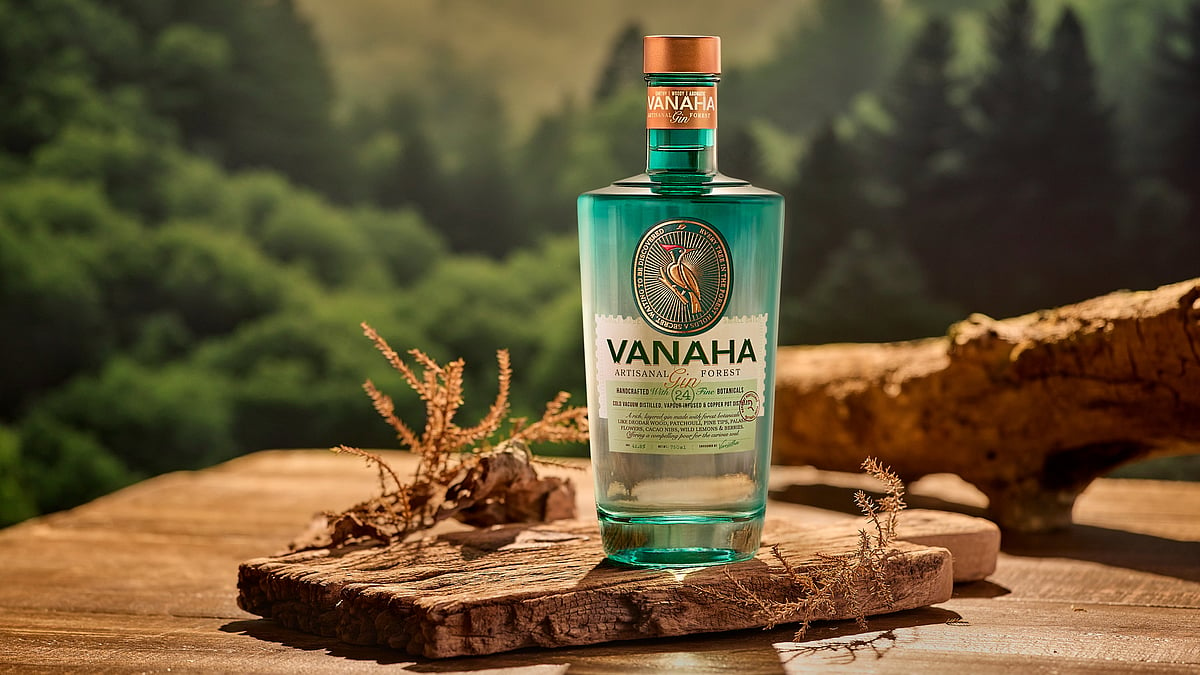
Premium Indian gin distillers have India’s biodiversity as a playground of flavours, and they are taking full advantage. Hapusa and Stranger & Sons both use the aromatic and flavour-forward gondhoraj limes as a key botanical. Originating in eastern parts of India, it is India’s answer to kaffir or makrut lime, but with a gentler aroma and a delicate taste compared to regular limes. On the western coast, Malhar Citrus gin by Paul John distillery uses local Indian key lime, easily available in most households. Nilgiris gin uses flavours of the Western Ghats like mace, nutmeg, cinnamon, Nilgiris tea and betelnut leaf. Samsara’s Vale of Paradise uses vetiver, rose and hemp seeds—all extremely indigenous and recognised flavours. Mohulo gin, by the makers of Smoke vodka, has used mahua flowers found wild across central India as the star botanical. Revelry Distillery’s Vanaha uses forest elements like palash or flame of the forest, and deodar wood chips.
Himmaleh Spirits, parent company to Kumaon & I and Jin Jiji gins, uses timur berry (Himalayan Sichuan pepper) for the former and Darjeeling tea as the key botanical for the latter. “India’s incredible ecological diversity means that every region expresses itself through distinct aromas, flavours, and ingredients. It is more than geography—it’s the interplay of altitude, climate, soil, local biodiversity, and the cultural traditions that have shaped how botanicals are grown, foraged, and used across generations,” explains Ansh Khanna, Co-founder, Himmaleh Spirits.
For the few botanicals that make it in the final list for a gin, many don’t. Vaniitha Jaiin, Founder and CEO of Vanaha Gin, Revelry Distillery shares that they distilled more than 200 botanicals individually before making the final selection. In the end, over 175 were left out. “I would not call them rejected because they were bad botanicals. It had to add its own layer to the gin, and it also had to mingle with the others without dominating the final profile,” she adds. Many botanicals that worked beautifully on their own did not necessarily work within the final blend. The reality is that developing a gin recipe rarely involves outright rejecting botanicals. It’s more about evaluating how each ingredient contributes to the final balance and complexity.
The originality driven by curiosity about unique botanicals is resulting in an experiential purchase pattern for Indian gins. They make great gifts, especially when travelling abroad, driving sales in the travel retail segment. Indian gins still have time to become a collector’s item or investment proposition. As global consumers increasingly look for authenticity and provenance, Indian gin has a compelling story to tell. But it should not be compared to other gin-producing nations like the UK, Australia, Japan or even Spain. “I think comparisons can sometimes be limiting. They should not be the benchmark for what Indian gin becomes. India's advantage is range. Few countries can draw from the diversity of ingredients, flavours and culinary traditions that we can,” believes Mehra.
The flavour journey of Indian gins is already recognised with a barrage of international awards being bestowed upon them. The production capability and quality are no longer the challenge. “India is still articulating a unified global identity for its craft spirits. That fragmentation is not a weakness, but it does mean the category is still finding its collective voice,” adds Samarth Prasad, Co-founder, Himmaleh Spirits. The bigger challenge is building distribution, market access and earning global familiarity.